


A member misplacing the decimal point for an amount on their claim has ripple effects downstream. The admin returns the claim for correction, the member updates the claim, and the admin reviews the updated claim. Hopefully, the cycle ends there.
Receipt-powered claims break this cycle by changing task assignments. Instead of depending on members, expense info is automatically extracted and populates claim fields with optical character recognition (OCR) technology. As a result, members spend less time filling out claims and fewer claims get returned for typos.
The manual-entry claims problem
The Internal Revenue Service requires substantiation for flexible spending accounts (DC-FSAs, FSAs, LP-FSAs) and health reimbursement arrangements (HRAs). In other words, when seeking reimbursement, FSA and HRA benefit program members must provide proof, like a receipt, that the expenses were indeed eligible for reimbursement.
Traditionally, members are asked to both:
- Attach expense documentation, AND
- Manually enter expense details
Expense documents like receipts usually list the date of service, merchant name, amount, and more. Why ask members to transcribe information the benefit platform can read on its own?
The submit-review-submit-review cycle
If a submitted claim doesn’t match its attached receipt, the FSA or HRA plan administrator returns the claim for correction. The member must then either correct the claim or submit new documentation. This is how the submit-review-submit-review cycle begins. Members spend time submitting claims and receipts, and admins spend time reviewing claims and receipts.
Common errors
Required claim fields vary, depending on the benefit, but common fields include date of service, amount, and vendor. For dependent care flexible spending accounts (DC-FSAs), provider name, address, and tax ID are also required. Here are some common errors we’ve seen when claims and receipts don’t match:
- Date of Service: Multiple dates are often included on a receipt. The date when the services were actually rendered is the one needed.
- Amount: Benefits like HRAs often have thresholds. Members often try to calculate the eligible amount on their end, instead of just including the provider’s required amount on the bill.
OCR technology can help reduce these common errors by reading the correct date and amount directly from the receipt.
How receipt-powered claims work
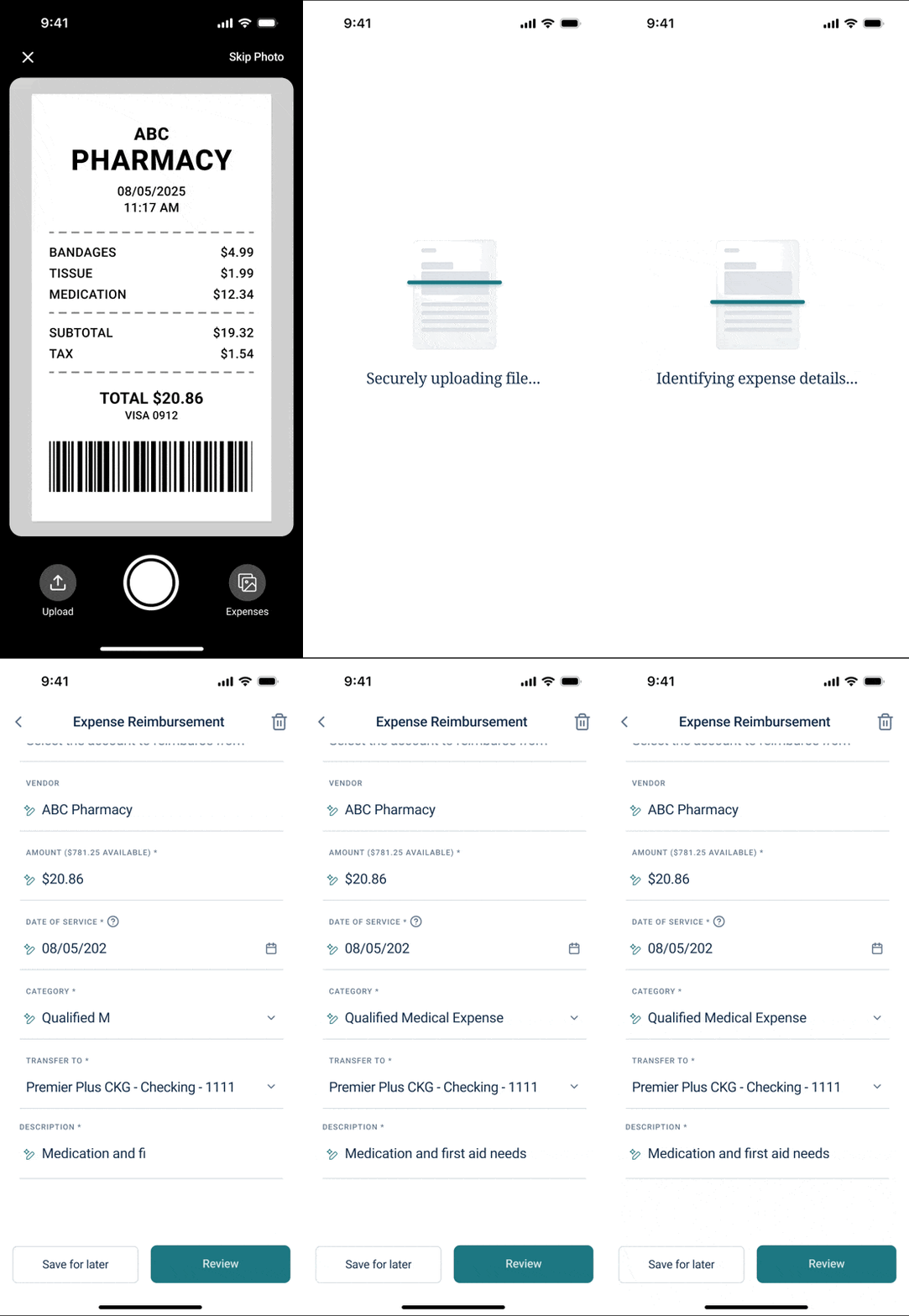
Receipt-powered claims flip the reimbursement experience. Members upload their receipt first. OCR technology scans the document, identifies key information, and populates claim fields automatically. Members then review the pre-filled form, add any missing details, and submit. The responsibility of transcription is shifted from the member to the platform.

Behind the scenes, the technology uses optical character recognition and machine learning to read documents and map information to the correct claim fields. Autopopulated fields are marked with a magic pencil icon, so members know which information was extracted during the scan.
Supported expense documentation
First Dollar technology infrastructure is used to power commuter, FSAs, HRAs, HSAs, and LSA benefits for employers and employees. These benefits have a wide array of eligible expenses, which is why we trained our technology to read:
- Daycare center receipts
- Explanation of benefits (EOBs)
- Fitness center receipts
- Insurance premium invoices
- Letters of medical necessity
- Medical invoices
- Merchandise receipts
- Parking garage receipts
- And more.
Beyond receipt scanning
The Health Wallet's claims experience uses machine learning to recognize and classify documents, and map extracted information to claim fields. Here are some of the ways this technology is smart:
- Contextual field mapping. Information is mapped to correct claim fields even when receipts may use different labels.
- Layout intelligence. Reads multiple types of expense documentation, including drugstore receipts, medical invoices, insurance EOBs, itemized or summary, portrait or landscape orientation.
- Noise-resilient text recognition. Designed to scan and capture required info for different levels of quality, including blurry or low-contrast images, shadowed or dark corners, wrinkled or bent/kneaded receipts, or images taken at an angle.
- Currency normalization. Recognizes different currency formats, like $25.00 and 25, and ignores non-reimbursable fields like discounts, gift card balances, loyalty points, and rewards program messages.
- Date format & orientation flexibility. Converts various date formats (e.g., 10/31/25, Oct 31, 2025, 2025-10-31).
- Merchant logo recognition. Recognizes popular brand logos (e.g., Target, Walmart, CVS) to identify merchant names for scenarios where the merchant's name is not given in writing.
Working behind the scenes
Have you ever filled out your name on a digital application and then been asked to share your ID? Or written your health group number on a new patient form, then been asked for your insurance card?
These frustrations are fixable. And we’ve seen this happen in many parts of the financial services industry! Mobile deposits, bank account onboarding, expense reports—the philosophy behind our claims experience follows a long line of fintech improvements.

Technology has made some of its most significant impacts when it improved an existing user experience, not when it introduced a new feature. The goal isn’t to create a new button, a new step, or a new product name—it’s to meet the needs of the people who will use the technology.
Not another name to remember
Members do not see the term "receipt-powered claims" in the app. In fact, receipt-powered claims is an imperfect descriptor, as Health Wallet users making an HSA reimbursement will also benefit from this embedded technology experience.
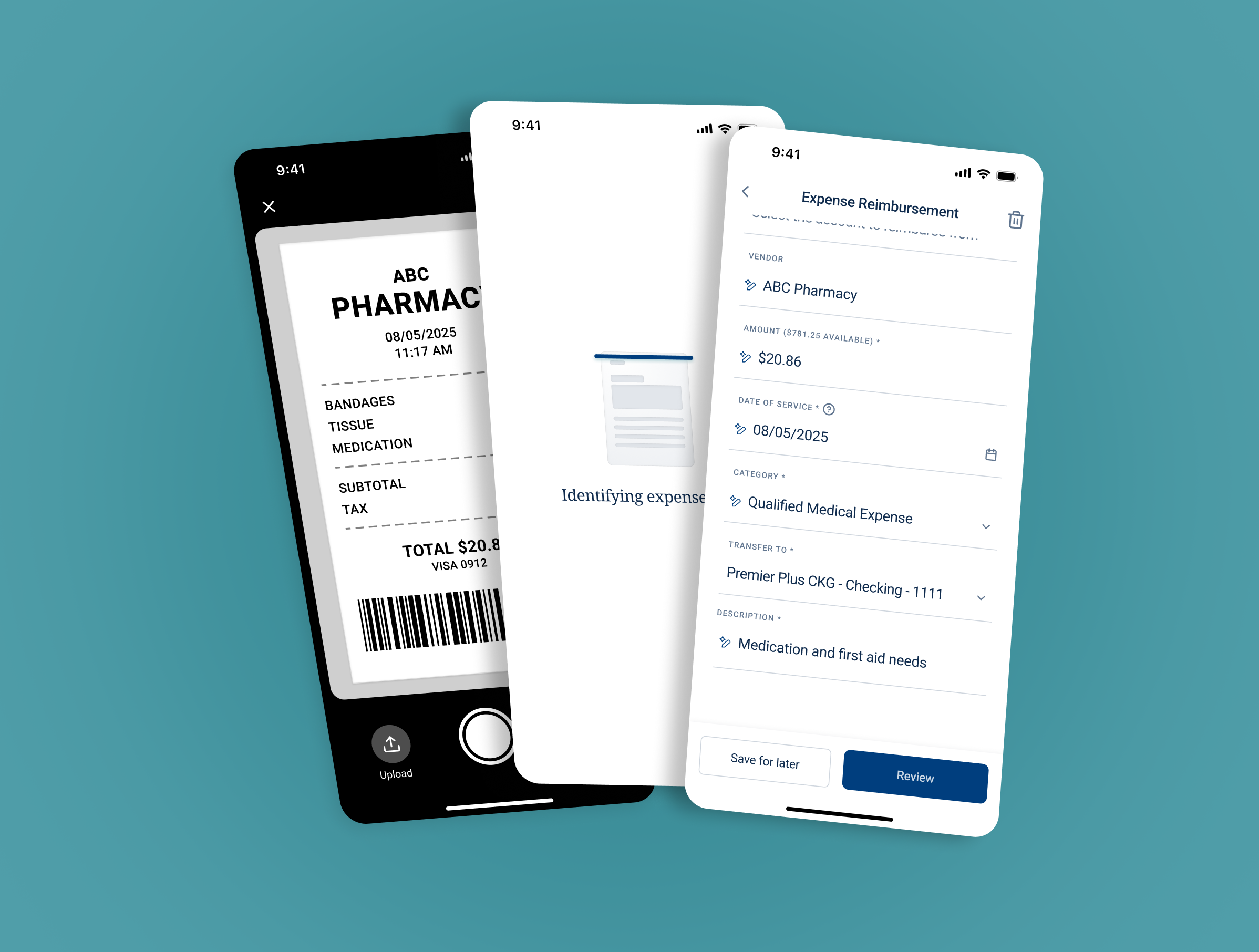
Our goal wasn’t for members to remember another feature name, but to improve the reimbursement process for everyone. That’s why we embedded OCR technology directly in the Health Wallet app reimbursement experience. One step eliminated, dozens of keystrokes saved, accuracy improved, zero extra clicks required.
Why this matters
Embedding smart technology within the reimbursement process does more than just allow members to skip a step. It improves the accuracy of submitted claims, which saves admins time reviewing.
Members get:
- Faster claim submission with fewer steps.
- Fewer rejected claims due to member errors.
- Higher claim completion rates with simplified claims process.
Admins get:
- Fewer claims to return for corrections.
- Reduced member questions about claim forms.
- Less time spent on manual claim review due to fewer returned claims.
Make it yours
Like all platform features, our claims experience technology can be white-labeled and offered under partner brands and logos. Your benefit program members get the benefit of an easier reimbursement experience, and your brand gets the credit.
A better reimbursement experience starts here
By making the claims submission process a simple snap-and-verify workflow, we’ve saved members and admins time and improved claims accuracy. And if you partner with our platform, you and your clients can also benefit from receipt-powered claims.


.png)
